
SYMBOLS OF SUCCESS:
Know How to Show that You Know What You Know
By Joshua Vise – September 4, 2025
What’s a digital badge?
Lewis Hamilton is a British Formula One driver for Ferrari who has won seven Championships. I have a driver’s license. Clearly, we are equals, right? Nope! I am a competent driver, but he is a world champion professional driver.
Even when two people are considered competent at a skill, ability, or task, there can be a wide gulf between their actual abilities. So how are we to know where someone stands with regards to a skill? Enter “Digital Badging”.
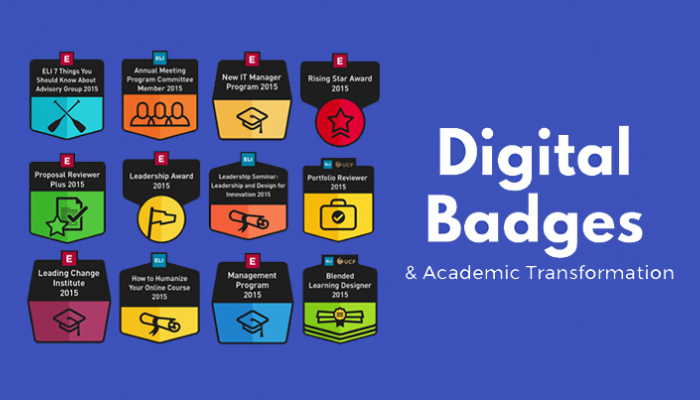
A digital badge displays that the owner of the badge has achieved a particular goal or possesses a specific skill (American College of Education. 2021). They act as a visual marker of an achievement that is awarded in response to the completion of pre-specified criteria, and they exist in a virtual space (Fanfarelli and McDaniel. 2015., via Rosenberger. 2018).
So what?
Now you know what a digital badge is, it is time to take a moment to truly appreciate what it does. A digital badge is more than just the symbols of our success, but a valuable professional resource. Digital badges contain metadata (such as the recipient, issuer, badge purpose, etc.) that allows others to verify the badge’s validity (Virtualbadge.io. n.d.). This means that digital badges can be created to:
- Recognize a particular achievement, such as the completion of a course.
- Verify professional affiliation, such as membership in a group.
- Indicate participation in an event.
- Easily share links to portfolios, or other outside data.
Additionally, badges can serve as a motivator to encourage learning, participation, and collaboration (Wikimedia Foundation. 2025), and are quickly becoming an appropriate, easy, and efficient way to reward participants for skills obtained in professional development or training (Shields & Chugh. 2017). As an open source Badges can be created to fit nearly any situation or learning experience, with the only limitations in the minds of the creator.
Now You Know, So Let’s Go!
Now that you understand the value and utility of a digital badging system, why not try creating your own! Below is a step-by-step guide for the creation of your own digital badge. This tutorial uses the Free Open Badges Creator by Virtualbadge.io, and can be found at https://www.virtualbadge.io/resources/free-open-badges-creator

https://cdn.prod.website-files.com/5f51ff346f381e4105e072c5/651e8b4139465189753d58f1_digital%20badges.png
- Decide what particular skill or achievement you would like to recognize.
- Select an appropriate image that could be used to act as the symbol for your digital badge. Virtualbadge has their own badge designer tool, or you could use other software to create this image. Either way, keep in mind that you will want this image to be relatively small and simple, yet interesting enough to stand out.
- Enter the recipient’s email address.
- Enter the issuer’s name and email address. You will be asked to confirm this email by entering a verification code.
- You can now download your badge design as a .png file to be sent individually. Paid versions of this service allow you to send to multiple recipients simultaneously, integrate them with other websites like Linkedin, and utilize other effective analytics.
It Doesn’t Stop Here!
As digital badges become increasingly utilized and accepted as a valid credential system, the value of the badges will increase. Of course, for this to occur, the recipients need to understand that their badges are not simply “stickers”, but actual symbols of achievement. Educating students about why they should want it, how they can get it, and what it can be used for after receiving it (Rosenberger. 2018) will be crucial in order to maximize their effectiveness.
Resources –
This Module 9 Assignment was created using the WordPress webpage creator tool. Images are not embedded, but hosted on their original source site. This source information can be seen as captions under each image.
Academic Resources –
American College of Education. (2025). TECH6303 Digital teaching and learning: Module 9 [Part 2 presentation]. Canvas. https://ace.instructure.com/courses/2047028/external_tools/118428
Rosenberger, K. (2019). Designing Digital Badging Programs: Findings from an Interview-Based Study with Instructional Designers. TechTrends, vol 63. https://doi.org/10.1007/s11528-018-0349-7
Shields, R. & Chugh, R. (2017). “Digital badges – rewards for learning?”, Education and Information Technologies, vol. 22, no. 4, pp. 1817–1824, doi: 10.1007/s10639-016-9521-x
Wikimedia Foundation. (2025). Digital Badge. Wikipedia. https://en.wikipedia.org/wiki/Digital_badge#Functions
 Joshua Vise